Written by: Jay Roberts
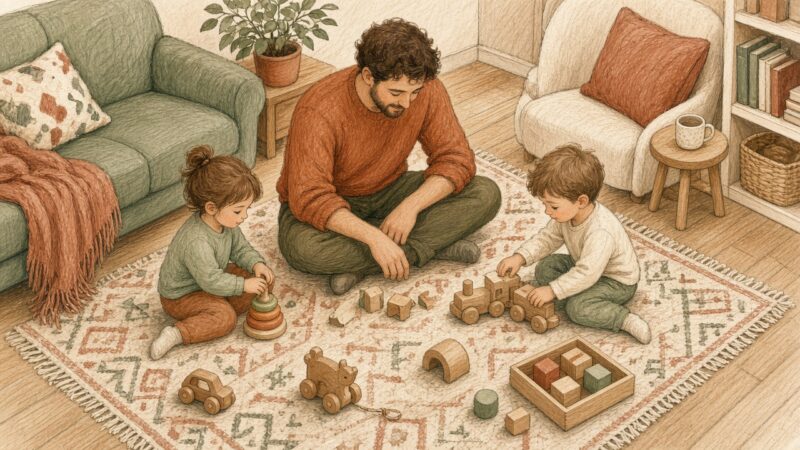
When I first became a dad, I was twenty-six years old. Finding out I was going to be a parent was a shock, a wake-up, a shift in perspective; to discover it was twins was petrifying. Soon after they were born, I learnt, realised, and understood so many things, many of which I continue to learn every day. Since then, I’ve gone on to have another four sons and a daughter and have three stepchildren too. One son and my daughter are not mine biologically, but they are my children, and that’s how I see them. For my stepchildren, I always aim to treat them the same as the others. I never want any of our children to feel they are treated differently. As a blended family, my wife and I have ten children between us, with their ages ranging from one to twenty-one. There are eight boys and two girls. We have neurotypical and neurodiverse children. The oldest child’s name begins with A, and the youngest, Z; we have quite literally an A-to-Z of children. Four of our children are now adults, with one a dad himself. At any given time, we tend to have at least five children in the house; I just can’t say which five, but two are permanently with us. Biologically, I have boys, but I’ve learnt and adapted how to care for girls too; I happily buy them sanitary products without worry!
As a dad, I see fatherhood from all perspectives. No age is easier than another, no gender is easier to parent than another, and neurological capabilities vary across them all. Each child is different, and each needs a different approach to get the best from them. Whilst I’ve been a parent for twenty years, I’ve also been a children’s social worker for fifteen, and so have the benefit of my expert knowledge too. In my practice, I can relate to the parents I work with, despite what some say. I understand first-hand the challenges of how hard parenting can be but how rewarding it can be too. I will always maintain that no matter how challenging my day has been in professional practice, my wife has had it tougher at home with the kids. I love each one of our children, unconditionally, for the wonderful individuals they are, although sometimes they can be very testing! Now, someone please pass me a coffee; I need it for my own survival or just to make it through the morning school run. Is it too early for a beer?
I always think it’s vital to have understanding of how you want your family to be, to consider what it is you’re wanting to achieve, and to take purposeful time to reflect on this.
“Positivity is maximised when you consciously cultivate a reflective environment.”
For me, values and identity are the foundation of families. Values and identity are your agreement with yourself on how you want to be and what characteristics you want to portray. To be a good family man, I see the core values to be respect, empathy, encouragement, understanding, love, kindness, and acceptance, to name a few. I consciously work on myself to develop these. Over time, they will compound and lead to being as close to this as possible.
Being a parent has one sole fundamental goal: to get your child to be as independent as possible when they’re eighteen. When they’re younger, it can be hard to think it’s possible, especially when you have boys who are flying down the stairs on pillows and mattresses, almost knocking themselves out at the bottom or calling you as a taxi driver who never gets paid. Of course, getting to independence takes many twists, turns, happy times, challenges, celebrations and stresses. It’s vital to your child’s development that you always remember your core objective: to get them to be independent. Often, parents lose sight of this and instead give their main focus to being friends with their child. Of course, we all should want positive relationships with our children, but it’s crucial to never lose focus on the parent-child dynamic. Without maintaining this, you run the risk of children becoming increasingly defiant, stemming from their power struggle with you, which, as they get older, becomes so much harder to manage. A teenage tantrum is arguably the same as a toddler tantrum, just with more colourful words, and so to some, this can be intimidating.
When I tell people how many children I have, the first thought for most is that our house must be chaotic. That, however, couldn’t be further from the truth. There’s noise, of course, but that comes with having positively developing children playing and young people growing. I strongly believe in children and young people having space to take safe risks, be messy, learn by failure, and to be curious and creative. It’s in these moments that we learn. We don’t grow from staying in our comfort zones; we grow from pushing outside of that space. By keeping your child anchored and reliant on you, you run the risk of regression in their development and so aren’t doing them any favours. In our home, we set clear boundaries, which centre around two aspects. Respect your family and home and develop a growth mindset reflective of your age. For my family, I adopt a growth mindset to influence our children to buy into it. Our children, of course, have no idea that the identity and values we set for our family are conscious and influencing them daily. I like to think we’re doing right by our children and that they themselves will understand when they see how much they’ve grown further down the line.
There are two main theories behind child development: that of Piaget and Vygotsky. I won’t bore you with extensive details of each, but in summary, Piaget considers that children develop in stages by age, and by Vygotsky considers that children develop at their own pace in different areas. Ideally, I like to implement both these theories, recognising that our children should be developing their abilities as they age, but aligned with that, will also be excelling with different things individually.
I’m not writing this, saying I have all things parenting figured out; I don’t and it’s far from. Every day I continue to learn and look for new ideas; I like to be innovative. Just when you have things seemingly worked out, children have a wonderful way to prove you wrong. How many times does your child say they love a particular flavour of yoghurt, so you buy many, and then they say they don’t like them anymore and you’re left with a fridge full. For me, I find teenage years most challenging, due to the push back and resistance. Like many, we’ve seen our teenagers ignore us, ignore their surroundings, speak down to us and never clean up after themselves, and for some reason, they appear to think they’re the only person in the world and that somehow the world owes them something. When you raise any of these issues with them, they make out as though you’re the issue, whereas hormonal changes are clearly the changing factor. Teenagers are exploring their identities, working out who they are, and with it, their opinions are forming. Whilst I always want to hear their views, often, these are influenced by external factors such as social media, and so can easily be misguided.
“If you water grass and give it sunlight, it thrives and becomes greener, but if you don’t, the grass suffers. Our families are no different”.
Alongside developing a growth mindset, one of the biggest takeaways I have as a dad, and which I would advise to all dads, is to strongly promote acceptance and authenticity. Recently, one of my older sons shared with me that he’s gay. My response was to praise his bravery, shared that I’d known for years but explained he needed his own realisation, asked him if there’s anyone he likes and what he wanted for tea; he threw his arms around me and told me he loved me. It’s crucial to remember that your child’s life isn’t your life, as they are their own person and on their own path. Accept them for who they are, supporting and directing them to get there.
For each word you say, or action you take, it influences and shapes your child to be the adult they become. Some things they’ll like, some they won’t, but what matters is that you make your parenting decisions based on the information you have and keep focused on developing your child to be independent and balanced. As a dad, you model a lot of this. Recently, my young stepson said to me that he loves how I treat his mum, adding that he likes how kind I am to her. Just by seeing my actions daily, it is shaping his young mind to offer kindness, and I hope this embeds as his identity in future relationships. I am hopeful our children will learn from what I show them.
“Raise your action standards, not your voice”.
I’ve done a lot of research and learning on developing winning team cultures, and I see family as being exactly that, a team. We’re a group of individuals, focused on achieving the same goal; to better ourselves. As our family is a team, with conscious cohesion, our children don’t argue. Any issues are talked through, and they don’t compete with each other; they’re teammates. Children tend to be focused on themselves, as they’re navigating and finding their place in the world, whereas as a dad, my view is much wider, and my thoughts go into how we can be successful as individuals and as a group. One of the core factors to creating a winning team, is to create psychological safety. It’s vital that you understand what each of your children need from you, as they’re all different, and so have different needs. Understand what makes them happy, what motivates them and how you can make them feel important and valued as an individual. To develop togetherness, I like to set my family different fun challenges. We’ve done all sorts, blindfolded makeovers, spelling your name with random objects around town or making adverts for random products when in shops. All entries are sent to our family chat, and I decide the winner, who gets sweets, or in my wife’s case, a deserved glass of wine. The prize may not be substantial, but the togetherness gained is of much value.
By creating this type of environment, goes some way to developing a winning culture and you’ll find greater cohesion within your family, where excelling becomes more natural. The Philadelphia 76ers are well known for having the slogan, “Trust the process”. You have time to develop your family, but each day must consciously commit to them, knowing that the desired outcome will be reached, one step at a time. It’s a principle I adopt within our home.
“Walk the journey before you talk the result”.
When I talk about success within families however, and my role as dad, I’m not thinking about an outcome of employment and high earning. Dad going to work and mum caring for children is a 1950’s approach to parenting; we’re well past that. Be present and influence.
“To be successful at anything, you have to choose and prioritise being successful at home first”.
Leadership isn’t just a quality within the workplace. I often think people assume they’re leaders, without actually implementing the skills necessary or developing an outcome worthy of being deemed a leader.
Leadership is about recognising the strengths in others, cheering for them and supporting them to grow as individuals. I use a “high support, high challenge” model to help our children grow. It’s necessary to make things a little harder each time a task is undertaken, but with that comes the caveat that support, encouragement and guidance is consistently provided. Growth brings the unknown, and the unknown brings discomfort. To lead is to make the discomfort more comfortable.
Men in particular, whether at home or work, often live driven by their own egos, only seeking to find their own gain, rather than gains from others. To have good leadership, however, is to praise those around you when things go right, but shoulder responsibility and take ownership when they don’t. In doing so, you protect others from regression and instead, support continual improvement. Days of leadership being authoritarian are long gone. To achieve positive outcomes, soft skills such as empathy and kindness, which demonstrate humility, will take you much further. Leadership is a way of being, that inspires and influences others to grow, develop and improve. To be a leader, is to want your children to outdo you, to celebrate their successes beyond your capabilities and to be happy for their individual successes.
Every family is different, but this is ours.