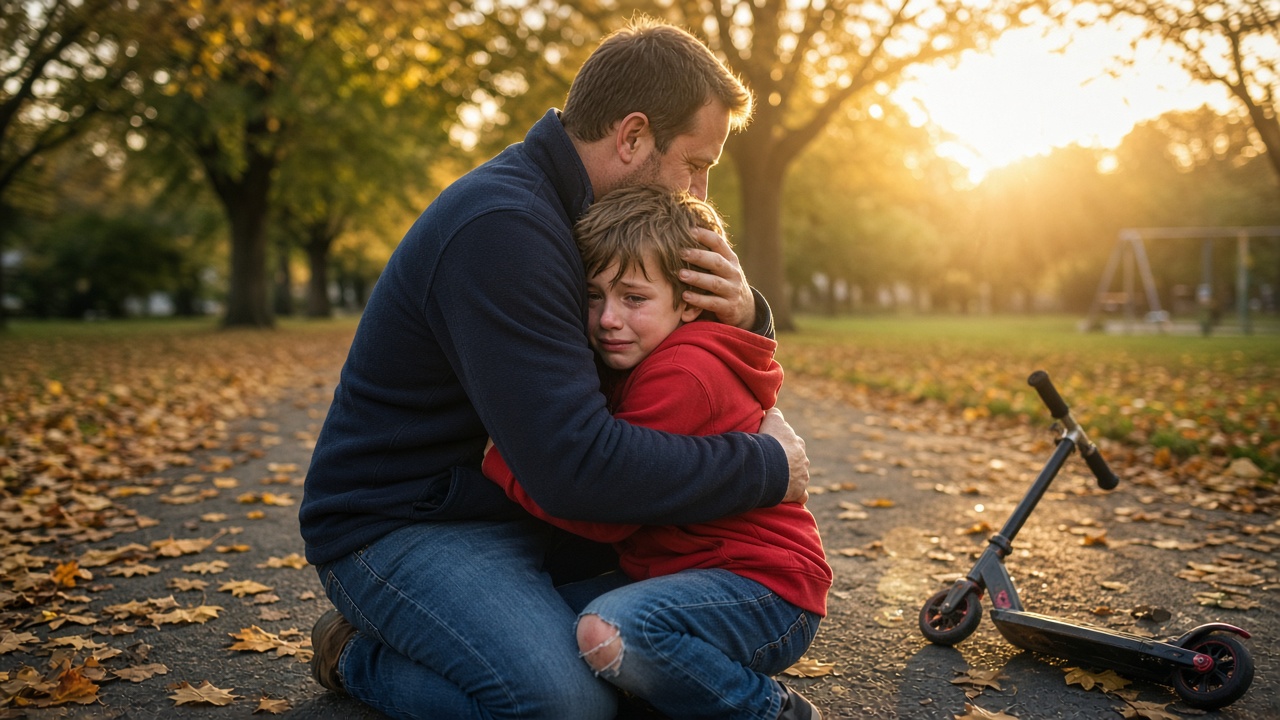
Right. Quick show of hands. Who had “big boys don’t cry” said to them as a kid? Scraped knee, lost football match, the day the hamster went. Somebody, usually meaning well, told you to dry your eyes and get on with it.
Yeah. Me too.
So it caught my eye when Netmums ran a piece on 23 October in which a family psychotherapist said “boys don’t cry” is a phrase parents should stop using. Not softened, not “maybe have a think about it”. Stop.
What the psychotherapist actually said
The expert is Fiona Yassin, a family psychotherapist and the founder and clinical director of The Wave Clinic. Her starting point is simple: “Crying is a natural way for a child or young person to express emotions like stress, anger, or fear. It’s a crucial part of healthy emotional development.”
And the bit that’ll sting a little if you’ve ever said it in a car park (guilty): “When a parent tells a child to stop crying, they are invalidating that child’s feelings and encouraging them to repress their emotions and true feelings.”
On boys specifically, she’s blunter. “Enforcing gender stereotypes can have serious consequences.” She goes on to say that telling boys they shouldn’t cry can leave them feeling ashamed and doubting themselves, so they shrink rather than show who they really are.
None of that is a telling off. The article is pretty upfront that most of us say “stop crying” because we’re rushing, or we’re in public, or we genuinely can’t work out what’s wrong and want it to stop for their sake. It’s a reflex. Usually a kind one.
But it’s still worth swapping out.
What you can say instead
The Netmums piece gives a list of 15 things to say instead of “stop crying”. There are actually 16 on it. I counted, because I’m that person. A few that stood out for dads, in my opinion anyway:
- “It’s OK to cry. I’m here for you.”
- “You don’t have to talk right now. I’ll stay with you.”
- “Would you like a hug or a little space?”
- “It’s OK to make mistakes. We can work it out together.”
- “I love you, even when you’re having a hard time.”
The hug or space one is the one I’d underline twice. Not every kid wants a cuddle when they’re upset. Some want you near but not touching. Some want you on the other side of the door for five minutes. Asking means you don’t have to guess, and you’re not taking it personally when they pick space.
There’s also a lot in there about not rushing to fix. You don’t need to solve the falling out with their mate, or the broken Lego, in the first thirty seconds. Sit with them. Then, once the breathing has slowed down, “what do you think would help?” is a much better question than “right, what’s the problem?” (Which, for the record, is my natural opener. I’m working on it.)
It lines up with what the NHS says, which is reassuring. The Every Mind Matters page on children’s mental health tells parents to regularly ask how their child is doing so they get used to talking about their feelings, and to take what they say seriously. YoungMinds, the children’s mental health charity, puts validating their feelings at the very top of its list for when a child tells you they’re struggling, and makes the point that your child doesn’t need you to always get it right. They just need to know you’re there.
Which is a relief, honestly. Because I don’t always get it right.
One idea from Yassin I hadn’t heard before: a family questions jar. A jar somewhere everyone can reach, anyone can drop in a question, a worry or a thought, and once a week you sit down together and empty it. Her example was a Saturday brunch.
Now, as an ex chef, any plan that involves a weekly brunch has my full attention. But I think the real point is the regular slot. Kids who won’t say a word when you ask them straight out will sometimes write it on a scrap of paper and fold it six times. And she’s clear it’s not meant to replace talking the rest of the week, just to make sure there’s always one time when everyone gets heard.
Would it work in every house? No idea. Ours would probably get a lot of questions about dinosaurs. That’s fine too.
Why it matters more for dads than we like to admit
Here’s the bit I keep coming back to. A lot of us were raised on “man up” and “boys don’t cry”, and plenty of us turned out fine. Ish. But it’s hard to argue that a generation of men taught to keep it in has been great at talking when things go wrong.
I’m not going to stretch one phrase into a statistic, because that would be daft. But it’s worth knowing that in England and Wales the male suicide rate was 17.6 per 100,000 in 2024, against 5.7 for women, according to the Office for National Statistics. Roughly three times higher. Nobody can pin that on one sentence said in a car park. It does make you think about what we’re passing on, though.
And our kids watch what we do far more than they listen to what we say. If they never see Dad upset, or never hear him say “I’m a bit fed up today, actually”, they’ll draw their own conclusions about what men are allowed to feel. The Netmums piece also suggests naming your own feelings out loud, alongside Yassin’s idea of making home a place where feelings are welcome. That one costs nothing. Feels a bit awkward the first few times, mind.
A note if your child is autistic
Quick one, because it’s close to home. Leo is autistic, and when he’s overwhelmed it doesn’t always look like crying. Sometimes it’s a full meltdown, sometimes he goes very quiet and disappears under a blanket. The National Autistic Society is clear that a meltdown is not the same as a temper tantrum, and it’s not bad or naughty behaviour. It’s what happens when someone is completely overwhelmed.
So the “hug or space” question really matters in our house. Most of the time Leo wants space, low light and no talking, and then a chat much later, often sideways, while we’re doing something else. Leo does it Leo’s way, and honestly, fair enough. If your kid is similar, a lot of the list above still works, you just might be saying it with your eyes and a glass of water rather than out loud.
Maja, on the other hand, is four and wants the full cuddle, the full story and, ideally, a plaster for an injury nobody else can see. Same house, same parents. Totally different needs.
Crying is normal. Kids cry. Most of the time it’s a bad moment that passes. But if your child seems upset a lot of the time, has gone quiet or withdrawn for weeks, or something has changed that you can’t put your finger on, talk to your GP or their school. The NHS says a GP can refer children to local mental health services.
Older kids can contact Childline themselves, free and confidential, on 0800 1111. And if it’s you that’s struggling, Samaritans are on 116 123, any time, day or night.
Anyway. I’m still learning. I’ve still got “come on, you’re fine” on a hair trigger, especially at the school gate at quarter to nine with one shoe missing. But I’m trying to swap it for “I can see you’re really upset” and then just shutting up for a bit.
Turns out shutting up for a bit is half of it.
Join the Dadsnet crew
Get weekly dad stuff in your inbox, with useful ideas, honest stories and a bit of dad chat from dads who get it.

Join the Dadsnet crew
Weekly dad stuff that actually helps. No spam, just the good bits.