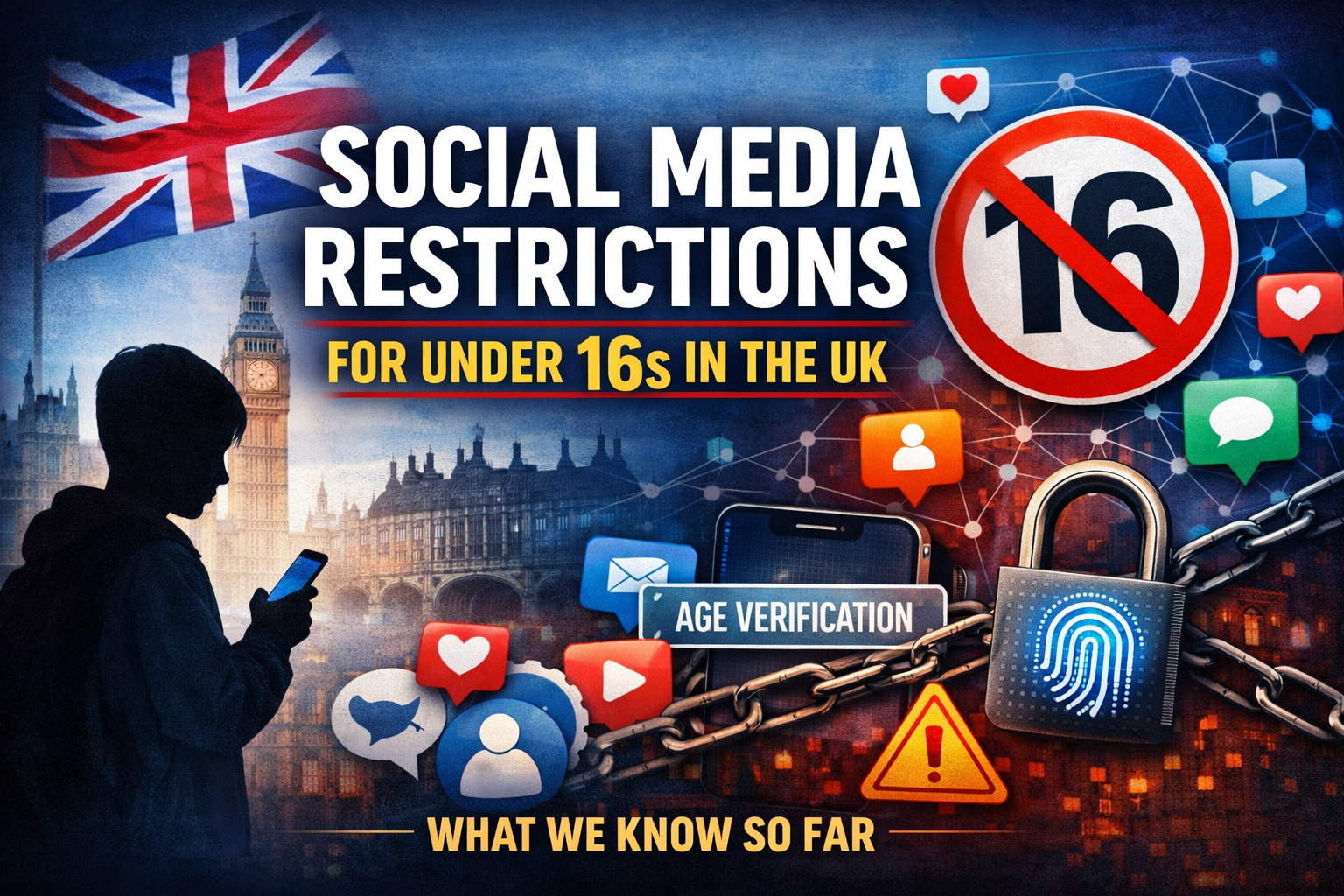
The UK is moving towards tighter rules for children on social media, with under 16 access now firmly on the political agenda.
But it is important to separate what is already law from what is being proposed, and what is still only being consulted on.
Ahead of the expected vote TODAY, here is what we know about the expected direction of travel, what could change next, and what it may mean for parents, schools, and platforms.
The headline: the UK is actively exploring an under 16 social media restriction
On 19 January 2026, the government announced a new consultation focused on children’s relationship with mobile phones and social media. That consultation includes options such as a social media minimum age, changes to how age is enforced, and limiting addictive design features.
At the same time, there is growing political pressure for an Australia style approach, including calls for a minimum age of 16 for social media access, and public debate around amendments in Parliament.
The key point: a blanket UK ban for under 16s is not law right now, but it is being seriously considered.
What is already in place: the Online Safety Act is forcing stronger protections for children
Even without a new under 16 ban, the Online Safety Act has already changed expectations for platforms.
1) Platforms have legal duties to protect children online
Government guidance says that from 25 July 2025, platforms have a legal duty to protect children online, including using highly effective age assurance in certain high risk contexts.
2) Ofcom has set out child safety measures and age checks
Ofcom published child safety rules and signalled stronger age checks, with measures intended to be introduced from July 2025, including safer feeds and stronger age assurance approaches.
In practice, this means many services are already preparing for, or rolling out, more robust age verification or age estimation, plus changes to how content is recommended to young users.
3) Data and design rules already apply via the Children’s Code
The ICO Children’s Code, also called the Age appropriate design code, requires online services likely to be accessed by children to design with children’s best interests in mind. That includes limits and safeguards around data use, profiling, and default settings.
So while a new under 16 restriction is being debated, there is already a strong regulatory base that pushes platforms to behave differently when children are present.
What could change next: the main options on the table
Based on the government’s consultation announcement and current reporting, the most likely directions fall into four buckets.
1) A minimum age for social media accounts set at 16
This is the big one. Ministers are consulting on whether to introduce a social media age limit and how enforcement might work.
Politically, this is being framed as an option similar to the Australian model, with senior figures saying no option is off the table.
What this could look like in real life:
-
A legal requirement for certain platforms to prevent under 16 account creation
-
Clear definitions of which services count as social media
-
A compliance regime enforced via Ofcom style penalties and audits, or via a separate legislative route
2) Stronger age assurance across more services
Even without a full ban, the UK can still tighten restrictions by requiring more services to run highly effective age checks and to treat under 18 users differently by default.
Ofcom already sets expectations around age assurance under the Online Safety Act. The next step could be widening the scope, increasing the standard of proof, or limiting workarounds.
3) Restrictions on addictive features aimed at children
The consultation also points towards limiting addictive mechanics such as infinite scrolling and streaks.
This matters because you can reduce harm without banning a platform outright, by changing how it keeps a young person hooked. Expect discussion around:
-
Turning off autoplay or endless feeds for younger users
-
Default time break prompts
-
Limits on notifications
-
Reduced algorithmic amplification for child accounts
4) Raising the digital consent age
One proposal that keeps surfacing is raising the digital age of consent for data processing from 13 to 16, which would have knock on effects for how platforms obtain consent and run personalised experiences for teens. This has been referenced in current reporting around the policy debate.
Phones in schools: linked, but not the same as a social media ban
The government announcement also emphasised expectations around phone free schools, with reporting that inspections may include phone use.
That is separate from a national under 16 social media restriction, but the two are being discussed together as part of a wider child wellbeing and online safety push.
Timeline: when might new rules actually happen?
What is clear right now:
-
The consultation launched 19 January 2026.
-
The government has signalled it plans to respond later in 2026, with reporting pointing to summer 2026 as a milestone for a response.
What is not yet clear:
-
Whether the UK will choose a full under 16 ban, or a set of tighter design and age assurance rules
-
How quickly any new law could pass Parliament, especially if it requires a new bill or major amendments
In other words, expect this to be a major 2026 policy story, with enforcement detail being the hardest part.
What parents should watch for in the coming months
If you are trying to stay ahead of changes, these are the practical signals that matter most:
-
Any official definition of which platforms are in scope
-
Whether age checks become mandatory for more services, and what methods are considered acceptable
-
Rules that force child accounts into safer defaults, even when parents do nothing
-
Limits on addictive design features that apply specifically to under 18s
FAQ: quick answers
Are under 16s being banned from social media in the UK right now?
No. As of 21 January 2026, the government is consulting on options, including an under 16 ban, but it is not currently law.
What is the UK doing already to protect children online?
The Online Safety Act duties for child protection began in July 2025, and Ofcom has published child focused measures and expectations around age checks. The ICO Children’s Code also sets design and data standards for services likely to be used by children.
What is most likely to change first?
The quickest changes tend to be platform led compliance shifts: stronger age checks, safer defaults for teens, and feature changes. A full under 16 ban would likely take longer because it needs clear legal definitions and enforceable mechanisms.