
Pupils in England will not be allowed to keep a phone in a bag or a pocket during the school day, under stricter government guidance due to come into force from September 2027.
That goes further than the “no see, no hear” approach some schools use now, where a phone can stay in a bag as long as it is not seen or heard. The government’s message, in the words of Education Secretary Lucy Powell, is that “school is for learning and friendship, not scrolling.”
What’s actually changing
Statutory guidance already came into force in June, making schools and trusts legally responsible for being phone free throughout the day. Ministers now say the next version of that guidance, from September 2027, will be clear that pupils should not have access to their phones at all while they are in school.
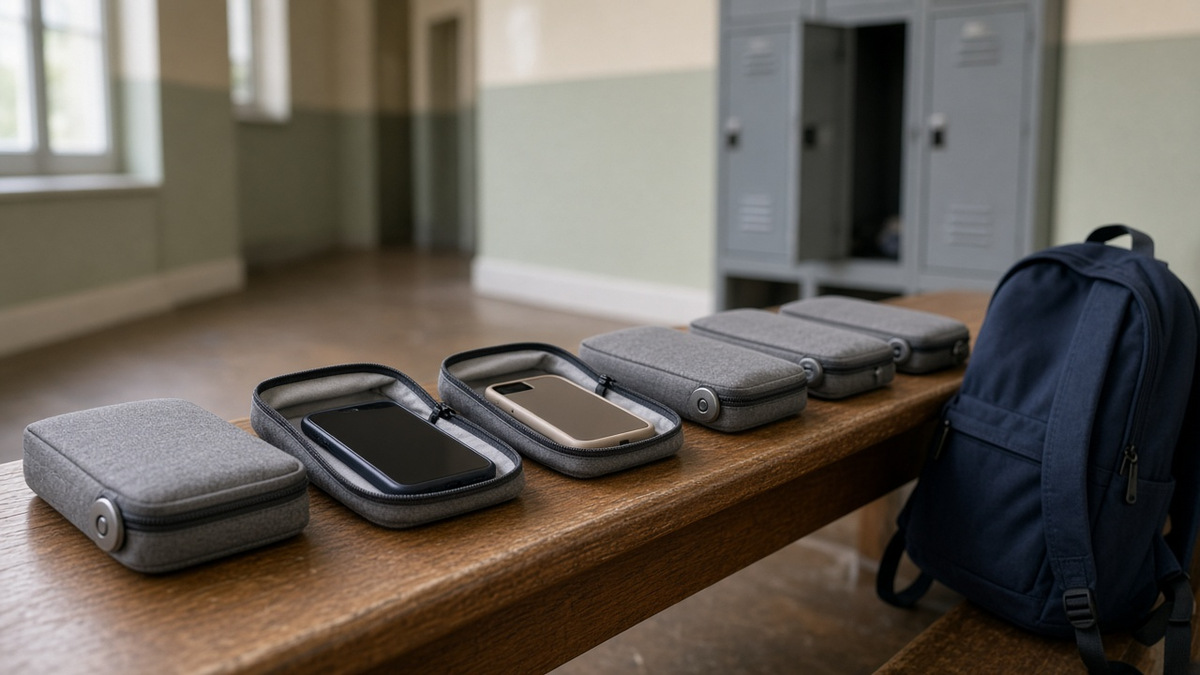
Schools will still decide how to do it. The BBC reports that some have invested in sealed pouches or secure lockers. Others collect phones at the start of the day, or have banned them from the site altogether. Powell told BBC Breakfast that this kind of policy can achieve a “whole school culture change”, and that is “what we want to see happening everywhere.”
Access to phones, the government said, “risks pulling children away from their learning and from each other.”
What one school is already doing
Clayton Hall Academy in Newcastle under Lyme, part of Windsor Academy Trust, did not wait for 2027. Headteacher Caty Reid introduced a tighter approach in January 2026, and the Department for Education shared her account with Dadsnet as a case study when today’s announcement was made.
Every student in Years 7 to 11 is given their own Yondr pouch. Phones are switched off and locked away on arrival, and unlocked at the end of the school day at 3.15pm. Students keep the pouch with them, so the phone is there but they cannot get into it. The same rules cover smart watches, ear pods and other connected personal devices. Staff meet students at the entrance and help them lock the pouches. Spot checks are used to keep the routine consistent, and parents who need to reach their child during the day go through the school office.
Reid said they spent two months consulting everyone involved before the change, then shared the arrangements with families. Students can still bring a phone for the journey to and from school.
“Students deserve time in their school day to concentrate on learning and enjoy being with their friends,” she said. “Phones are switched off and locked away on arrival, then unlocked at the end of the school day. Students can still bring a phone for their journey to and from school.”
Since the approach came in, she said, students have been playing and talking together more, and staff have reported better engagement in lessons. “Attendance has also improved, and we have seen fewer incidents of hurtful behaviour online. Those everyday moments of conversation and friendship are an important part of school life.”
It sits alongside the school’s wider work on wellbeing, including work with the NHS and on healthy sleep. “We want young people to benefit from technology when it helps them, while having time to concentrate, build friendships and feel they belong.”
The school’s mobile phones policy is published on its website.
Not every school will find this cheap
The tighter rules have been welcomed by the Children’s Commissioner for England, Dame Rachel de Souza, and by campaigners. Charlotte Ashton, co founder of Generation Focus, told the BBC that “no see, no hear” policies were not working and that pupils were still “TikToking in the toilets.”
Headteachers’ unions are more cautious about the cost. Paul Whiteman, general secretary of the NAHT, said phones can raise safety issues and be an “unhelpful distraction”, but that the more robust measures in the new guidance would “come at a cost.” Pepe Di’Iasio, general secretary of the Association of School and College Leaders, said the latest guidance “does at least provide some clarity”, but that school leaders “cannot simply make mobile phones disappear.” If every school is expected to have lockable pouches or other secure storage for every pupil, he said, the cost “will be very significant indeed” and “is not feasible unless the government puts in the funding required to meet these costs.”
That is not a theoretical number. Karl Harrison, headteacher at Burnage Academy for Boys in Manchester, told BBC Breakfast his school spent £20,000 on metal detectors and phone pouches. He said locking phones away had increased how much pupils socialised. “People now can talk to each other, instead of scrolling on a device. It’s also increased levels of focus in lessons because now there’s less distraction, and people are achieving higher grades.”
Powell’s response on funding, the BBC reports, was that she wants heads to have the autonomy to use the policies that work best for their schools.
Shadow Education Secretary Laura Trott said she was “delighted that Labour have finally listened to us and agreed to properly ban smartphones in schools.” She also backed a review of safety standards for technology used in schools, but criticised what she called a lack of “joined up thinking” over what new tech is being allowed in classrooms.
The rest of the UK, and the separate social media ban
This is about schools in England. Education is devolved, so the picture elsewhere is different.
In Scotland, the government has said it will introduce a new law to restrict personal phone use in schools, and ran a consultation over the summer. In Wales, the Senedd recently voted against a motion for a national statutory ban on phones in classrooms. Schools there are still encouraged to restrict phones during the day, but heads keep flexibility over how. In Northern Ireland, Education Minister Paul Givan launched a 12 week consultation in August on whether to ban mobile phones from schools by law.
The school rules are also separate from the UK’s coming ban on social media for children under 16, due in March. That is about access to platforms such as Instagram, Snapchat and TikTok, not about what a school does with a phone during the day.
What dads can do
If you have a child at secondary school in England, the useful move is a practical one. Find out what your school does now, and what it is planning before September 2027.
- Ask whether phones stay in bags, go into pouches or lockers, are collected on arrival, or are kept off the site altogether.
- If a pouch or collection system is coming in, talk the morning routine through at home so it is not a surprise on day one.
- If you need to reach your child during the day, use the school office rather than texting their phone. That is how Clayton Hall asked families to do it, and it is the bit that makes a locked pouch workable.
- A phone for the journey to and from school can still be allowed, as it is at Clayton Hall. The change is about the school day, not the walk or the bus.
- If your child needs a phone in school for a medical reason, ask the school how that is handled. The current guidance already expects schools to have a clear policy and to explain it to families.
None of this is a reason to panic about your teenager’s phone. It is a nudge to find out the actual rule at your school, back the morning routine if one is in place, and keep the conversation going at home about when a phone helps and when it gets in the way.

Join Dadsnet
Weekly dad stuff that actually helps. No spam, just the good bits.