Right. If you need a bit of good news this week, here it is. A seven year old from Ilkeston in Derbyshire set himself a target of £77 for people living with motor neurone disease. By the middle of November he’d raised around £5,000, and he’s still walking.
His name is Oscar Wilson, he’s autistic, and the whole thing started with a picture book. Netmums picked up the story on Saturday, after local paper the Derbyshire Times reported that his whole school is getting behind him next month.
What happened
Oscar read Try, a picture book by rugby league legends Rob Burrow and Sir Kevin Sinfield, written with Emma Adams and illustrated by Ben Whitehouse. It’s a story about two young boys trying to work out what makes someone a hero. Reading it got Oscar asking about the real Rob and Kevin, and about MND, the disease Rob died from in June 2024 at the age of 41.
So he made a plan. Walk every day for seven days in October, one day for every year of his life, and try to raise £77. Seven was Rob Burrow’s shirt number too, and the number has run through everything Oscar has done since.
He smashed the target. The Derbyshire Times reported he was on £2,647 by 22 October. Netmums says the MND Association put his total at £4,305 by 2 November, and by 19 November the Derbyshire Times had it at £5,000.
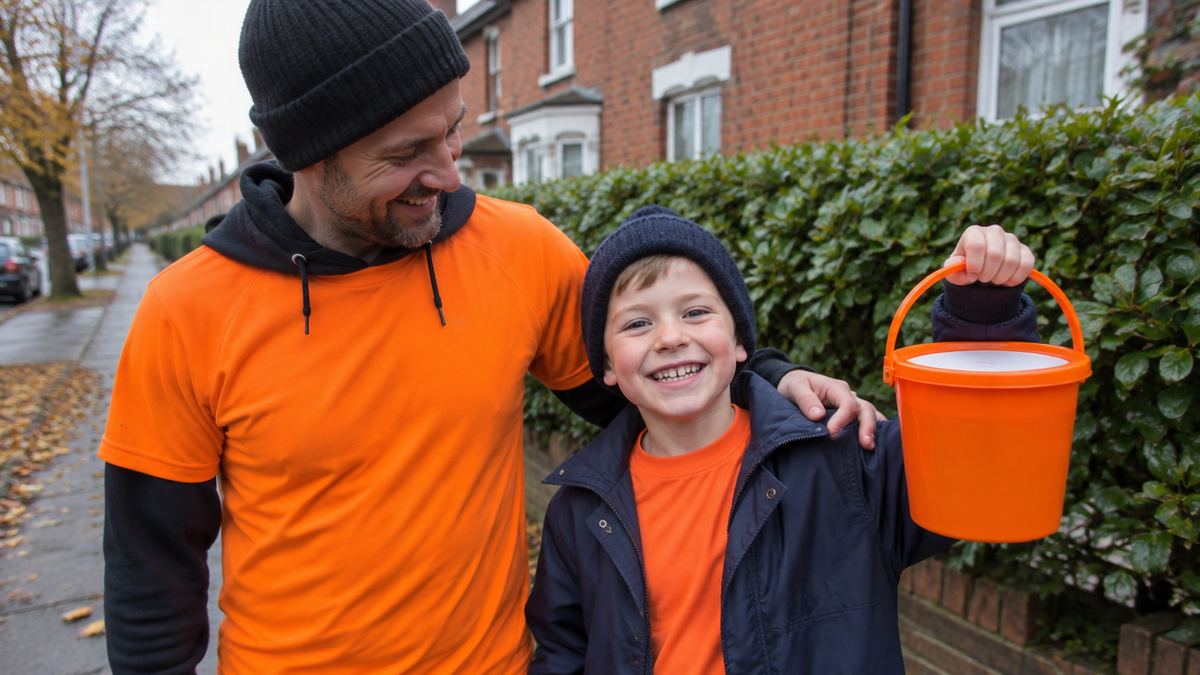
He hasn’t stopped. His new goal, as reported by both papers, is to walk 77 miles before Christmas. (His MND Association fundraising page describes it as walking every single day for 77 days, so either way, that’s a lot of laps of Ilkeston.) He heads out in his MND T shirt with a collection bucket, and he’s put in his own pocket money savings and picked out toys he doesn’t play with any more to sell for the charity.
“It’s all him, this is all his idea,” his mum, Charlene, told the Derbyshire Times.
His dad, Nikki, said: “What has made us proudest is that Oscar didn’t just want to ask other people to donate. He wanted to give something himself.”
The message from his hero
After Oscar finished his first week, Sir Kevin, who is patron of the MND Association, sent him a video message.
“Your fundraising has been absolutely fantastic, so keep doing what you’re doing,” he said, in words reported by the Derbyshire Times. “The whole MND community are behind you.”
According to the paper, a tearful Oscar said the message was “better than anything he had ever wanted.” Not a bad review.
It’s a fitting link. Sinfield started his own 7 in 7 challenges in December 2020 after Rob’s diagnosis, and finished the seventh and final UK one at Old Trafford on 3 October this year. The BBC reported that he and his team have raised more than £13 million for the MND community since that first run. Now a seven year old is doing his own version, one walk at a time.
What’s coming up
On Friday 18 December, pupils and staff at Oscar’s school, Cloudside Academy, are due to join him for his second to last walk, wearing something orange, the MND Association’s colour. Then on Sunday 20 December his family are hosting a fundraising party at Ilkeston Football Club, open to everyone, with a raffle, tombola, magician and DJ.
And Oscar’s Christmas wish? “My Christmas wish is to meet Kevin Sinfield and find a cure for MND,” he told the Derbyshire Times. Fair enough.
A quick word on MND
For anyone whose kids start asking questions after hearing about Oscar, here are the basics. According to the MND Association, MND damages the nerves that carry messages from the brain to the muscles, so the muscles gradually weaken. It can affect walking, talking, eating, drinking and breathing. Six people a day are diagnosed in the UK, more than 5,000 adults are living with it at any one time, and a person’s lifetime risk is around 1 in 300. The NHS says it usually affects people over 50, it shortens life, and there’s currently no cure, though treatment can help with symptoms.
That’s heavy stuff for a seven year old. Which is partly why Oscar’s story lands. He found out about something hard and decided to do something useful with it.
Why it matters to dads
Plenty of kids come home with a big idea. Raise money for the hospital. Save the hedgehogs. Do a sponsored something for the charity they heard about in assembly. The easy dad response is “maybe later” while you’re halfway through making tea.
Oscar’s story is a decent reminder of what happens when the grown ups say yes, keep it small to start with, and then follow the child’s lead. His family are clear it was his idea, and that he’s doing it his way. His fundraising page puts it nicely, saying “every walk is an achievement in its own right” and that “He does things in his own way, at his own pace”. Mum Charlene told Erewash Sound back in October: “He is simply being himself and showing that even the smallest actions can make a big difference.”
There’s something in that for dads of autistic kids especially. A clear number, a daily routine, a theme that means something to the child. That’s not a watered down version of a challenge. For a lot of kids it’s exactly the structure that makes a big thing doable.
If your child wants to do something similar
Let them own it. Start with a target they picked and can actually hit, like Oscar’s seven days and £77. You can always go again if it flies. Prep list first, ambition second.
Use the charity’s own fundraising page. Most big charities, the MND Association included, let you set up an online page through them, with you as the adult running it. Money goes straight to the charity and nobody has to count coins on the kitchen table.
You hold the bucket rules, not them. Collecting cash in public is more regulated than people think. In England and Wales, GOV.UK says you might need a street collection licence from your council for collecting in public places, including shop doorways and car parks, and you could be fined £200 for collecting without one where it’s needed. In Greater London it’s the Metropolitan Police. On private land, like a supermarket, you need the owner’s permission. The Fundraising Regulator also sets age limits, for example no house to house collecting by under 16s in England and Wales, and says children under 16 shouldn’t be left in overall charge of handling or counting money. Simplest thing is to ask the charity first. The MND Association’s own fundraising guide says you’ll need permission or a licence to collect in certain places and invites people to get in touch for advice.
Think before you post. Sharing updates is half the fun and it brings in donations. Just decide together what goes online, keep school uniforms and home addresses out of shot, and check privacy settings on whatever page you use.
Walking counts for a lot. The NHS says children aged 5 to 18 should aim for an average of at least 60 minutes of moderate or vigorous activity a day across the week, and lists walking to school or walking the dog as examples. For children and young people living with a disability, the guidance is 20 minutes a day, split into smaller chunks if needed. A daily sponsored walk ticks that box and gets you both out of the house on a grey November afternoon.
Use books for the big conversations. Oscar’s whole mission started with a story at home. Picture books like Try give you an easy way in to talking about friendship, illness and kindness, without it turning into a lecture. If questions come up you can’t answer, look them up together.
How to support Oscar
If you’d like to chip in, his MND Association fundraising page is still open, and his family share updates on Instagram as Oscar’s Mission for MND.
A seven year old, a picture book and a bucket. Miles of pavement in November weather. Thousands of pounds. Turns out you don’t need to be a rugby legend to run with the idea. You just need someone at home to say yes, and then put their coat on.

Join Dadsnet
Weekly dad stuff that actually helps. No spam, just the good bits.