#ad – this article is in partnership with Octopus Energy
We all know how it goes with phones. For the first year it’s brilliant. A couple of years later you’re charging it at lunchtime and it’s dying on the school run.
Buy a second-hand phone and you can sometimes pay an extra fifty quid or so to get a new battery put in, because everyone expects the old one to be tired. So if you’re thinking about an electric car, especially a second-hand one, it’s a fair question: does the battery go the same way?
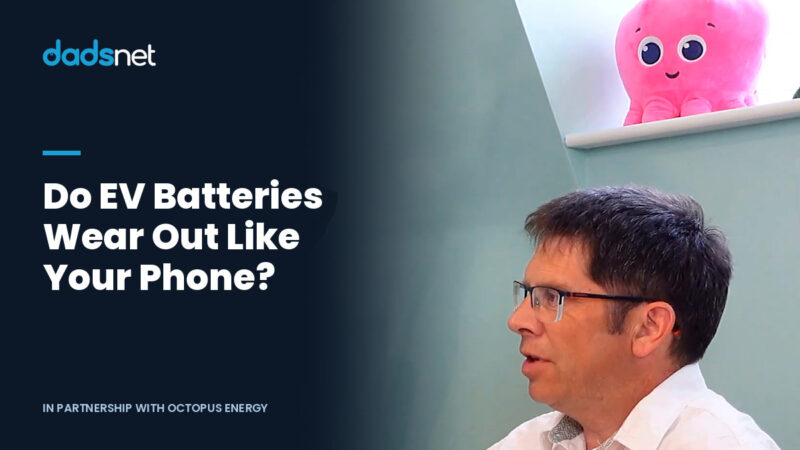
We asked exactly that in one of our recent videos.
Do EV batteries fade like a phone battery?
Short answer: a little bit, but nowhere near as much as you’d think.
EV batteries do degrade a bit over time, but it’s only a few percent. You’re not looking at a car that’s lost half its range after a few years. With a phone, you really do notice it. With electric cars, that’s not what we’re seeing.
So if the thought of a half-dead battery is what’s putting you off a used EV, it’s worth knowing the reality is a lot less dramatic.
What that means if you’re buying second-hand
Even if the battery only drops a few percent, it’s still sensible to ask about it when you’re buying used. A few questions worth putting to the seller:
- What range does the car show on a full charge now?
- Has the battery ever been checked, and is there a report you can see?
- Is any of the manufacturer’s battery warranty left?
None of that is complicated, and any decent seller should be happy to answer.
What happens to the battery when the car’s had its day?
This was the other question we wanted answered. There’s a lot of material inside an EV battery, so what happens to it when the car itself is finished?
It doesn’t just get thrown away. There are a few companies starting to recycle EV batteries, and that technology is picking up, so the materials don’t go to waste.
There’s also a second life for them. Home battery manufacturers have been taking the cells from old car batteries and repurposing them into home batteries. Octopus Energy has written about this too, saying that when car batteries eventually degrade beyond being useful in a car, they’re being repurposed for grid and home battery storage.
So an old car battery could end up storing energy in someone’s house. Not a bad retirement.
Where Octopus comes in
If you’d rather not take a chance on a private sale, Octopus Energy leases electric cars directly. According to its driving page, that includes brand-new and approved used EVs on monthly payments, with servicing, maintenance and repairs included. A home charger is included with many of the cars, and they’re set up to work with Octopus smart tariffs to keep running costs down.
The bottom line
If battery life is the thing stopping you from looking at an electric car, the worry is bigger than the reality. The battery does lose a little over time, but it’s a few percent, not half. And when the car is finished, the battery can be recycled or turned into a home battery rather than going to waste.
If you’re weighing up the switch, Octopus has cars, home chargers and EV tariffs all in one place, plus Electroverse for charging on the go.
Check out Octopus Energy today: https://bit.ly/4xXERKD
And tell us in the Dadsnet community: is battery life the thing putting you off a second-hand EV, or is it something else?