The first time I heard it, I thought Rohan had said mugged. We were having tea on a Thursday, he was telling Priya about a lad at sixth form who’d turned up in a new coat, and the line was something like “he absolutely mogged everyone”. I asked if the police had been called. Kiran laughed so hard she had to put her chapati down.
So then I decided it must be about cats. In my day (I know, I know) a mog was a moggy, the scruffy ginger thing that used to sit on the wall outside our house in Belgrave when I was a boy and judge us all. That got an even bigger laugh, and a long look from Rohan that said he was genuinely worried about me.
Naturally, a few days later, I tried to use it. I couldn’t find my reading glasses, and I stood in the hallway and asked who’d mogged them.
Reader, it did not go to plan.
Kiran, who is 14 and therefore the final authority on all language, told me that wasn’t what it meant and wasn’t even close. Rohan said I’d basically just said who’s stolen my glasses but worse. Priya, who was holding my glasses, said nothing at all, which I thought was a bit much.
Then on Tuesday, Collins named mogging its word of the year for 2026, and I realised this was not going away. The BBC said use of the word went up by 210 per cent this year. So it’s official now. I have no excuse.
So what does it actually mean?
Here’s the short version, for any dads who were also thinking about cats. To mog someone is to outshine them, outperform them or upstage them, most often in looks. It’s usually said in fun. It can be a compliment (“she mogged the whole red carpet”) or a gentle put down, and you can stick it on the end of almost anything. Height mogging, style mogging. Kiran tells me a friend’s dog once mogged her in a photo, and from the look on her face that still stings.
The example in the Collins announcement, as reported by The Guardian, was your friend’s sourdough mogging the loaf you spent all weekend on. I don’t bake. But I’ve stood at a wedding in a suit I thought was smart, next to a man half my age in a better one, so I understand the feeling.
Also on the shortlist, if you’re interested: carspreading, which is cars getting bigger and wider, ghost job, friendslop, bixie and fricy, which means fruity and spicy. I’ll admit I’m more comfortable with fricy. That one I can use at the dinner table.
The bit that made me put my tea down
I’m a pharmacist by trade, so I read the small print. And the small print on mogging is a bit less fun.
The word is usually traced back to AMOG, short for alpha male of the group. The BBC says it started out on bodybuilding forums and in incel and manosphere spaces online in the 2010s, then grew through looksmaxxing, which is groups of mostly young men swapping tips on how to make themselves as attractive as possible. A language expert at King’s College London told the BBC he thinks the word has largely been detoxified and that the young people he knows use it ironically now.
That matches what Rohan said, more or less word for word. “Dad, nobody means it like that.” And mostly I believe him.
Mostly is doing a bit of work there, though.
Because I had a read of the Internet Matters guide to looksmaxxing for parents, and some of it is properly grim. Some of it is harmless enough, skincare and haircuts and going to the gym. But it also describes mewing, where you press your tongue against the roof of your mouth to try to change your jawline, which it calls unproven. Crash dieting, which gets its own name. And something called bonesmashing, where people hit their own face with a hammer to try to change the shape of it. I read that bit twice to make sure I had it right. I did. The guide also points out that once a teenager starts watching this stuff, the algorithm tends to serve up more of it, and some of what comes next is a lot darker than a jawline video.
I asked Rohan over the washing up whether anyone at school did the mewing thing. He pulled a face and said a couple of boys in his old year did it for a bit. “As a joke, mostly.” There’s that word again.
Here’s the thing I keep coming back to. I’ve worked behind a pharmacy counter in Oadby for a long time, and teenage lads worry about how they look far more than they let on. They just don’t say it out loud, and they definitely don’t say it to their dad. The NHS describes body dysmorphic disorder as a mental health condition where someone spends a lot of time worrying about flaws in how they look that other people often can’t even see, and says it’s most common in teenagers and young adults, boys and girls alike. Its page on anabolic steroid misuse mentions adolescent boys with body dysmorphic disorder taking steroids because they don’t feel big enough. That’s a long way from a joke about a coat at sixth form. But it’s the same road, just further along.
And it’s not only boys. Kiran says for her friends it’s more about outfits and makeup and who looks best in photos, which sounds a lot like comparing yourself to everyone, all day, on a phone. I’m not sure that’s better.
What I’m actually doing about it
Not a lot, on purpose. My parents never once asked me what anything I watched meant, mainly because there were four channels and my dad controlled all of them. I don’t want to swing too far the other way and start interrogating people over the dal. But a few things seem worth doing, and none of them are hard.
I’m still using the word. Badly, deliberately. Getting it wrong has turned out to be a decent way in, because teenagers will happily explain things to a dad who is clearly hopeless. Internet Matters suggests keeping these chats casual, at dinner or in the car, so it feels like curiosity rather than an interrogation. That’s about where I’m at.
I’m listening for the other words. Mogging on its own is just slang now, like slay was a few years ago. The Internet Matters guide lists a few terms that would worry me more, including mewing, starvemaxxing (extreme dieting) and foid, which is a nasty word for women. If I heard that last one at my table, it would be a different conversation entirely.
I’m watching what they do more than what they say. The NHS list of signs for body dysmorphic disorder includes spending lots of time comparing your looks with other people’s, looking in the mirror a lot or avoiding mirrors altogether, going to a lot of trouble to hide things you don’t like, and picking at your skin. Internet Matters adds changes in eating or exercise and getting more secretive about what’s on the screen. Any one of those on its own is just being a teenager, to be fair. A few together, and lasting, is worth a quiet word.
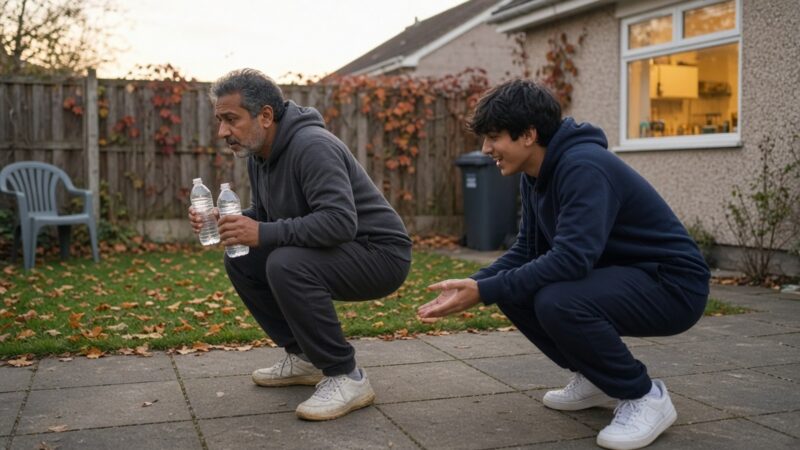
I’m watching my own mouth. I’m 54, Rohan is teaching me to squat, and I make a lot of jokes about my belly. I’m told that’s fine, it’s funny, but throwaway comments about bodies get heard, mine or anyone else’s. So I’m trying to praise the kids for things that aren’t how they look. Rohan’s patience with a terrible student. Kiran being funny. Anjali texting Kiran good luck from Sheffield before a test without anyone asking her to.
I learned about the Not interested button. Most of the big apps let you mark a video or post as Not interested, and you see less of that sort of thing afterwards. Internet Matters has the steps for TikTok, Instagram, YouTube and Facebook. I went to show Rohan. He already knew, obviously, and then showed me a quicker way.
If it’s more than a joke
If you think your teenager’s worries about how they look are taking over, so they’re avoiding going out, eating differently, or spending ages in front of the mirror and coming away upset, the NHS says to see a GP. For under 18s that might mean a referral to local children and young people’s mental health services.
If you want to talk it through first, the YoungMinds Parents Helpline is free on 0808 802 5544. It’s open 9.30am to 4pm on Mondays, Thursdays and Fridays, and 9.30am to 6pm on Tuesdays and Wednesdays, with a webchat on weekdays too. And your teenager can talk to Childline about body image on 0800 1111. It’s free and it won’t show up on the phone bill, which in my experience is the first thing a teenager will ask.
For the record, Kiran has now banned me from saying mogging at all, in the house or in public. Rohan says that’s fair. Priya says her dal mogged everything else on the table on Sunday, which, I have to say, it did.
Join Dadsnet
Weekly dad stuff that actually helps. No spam, just the good bits.