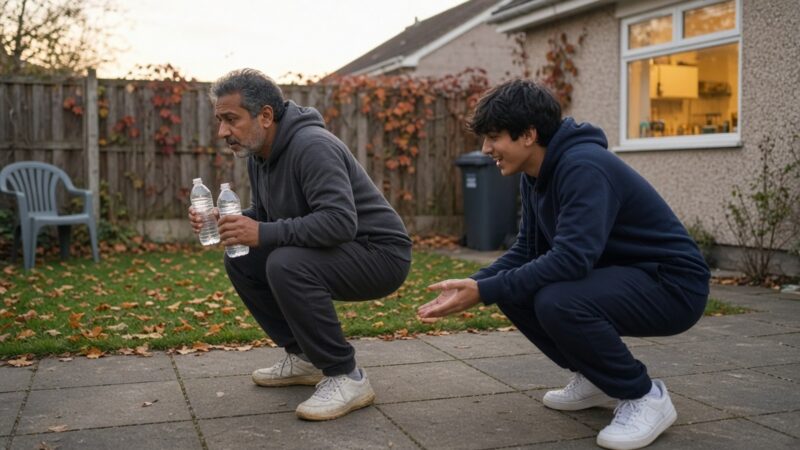
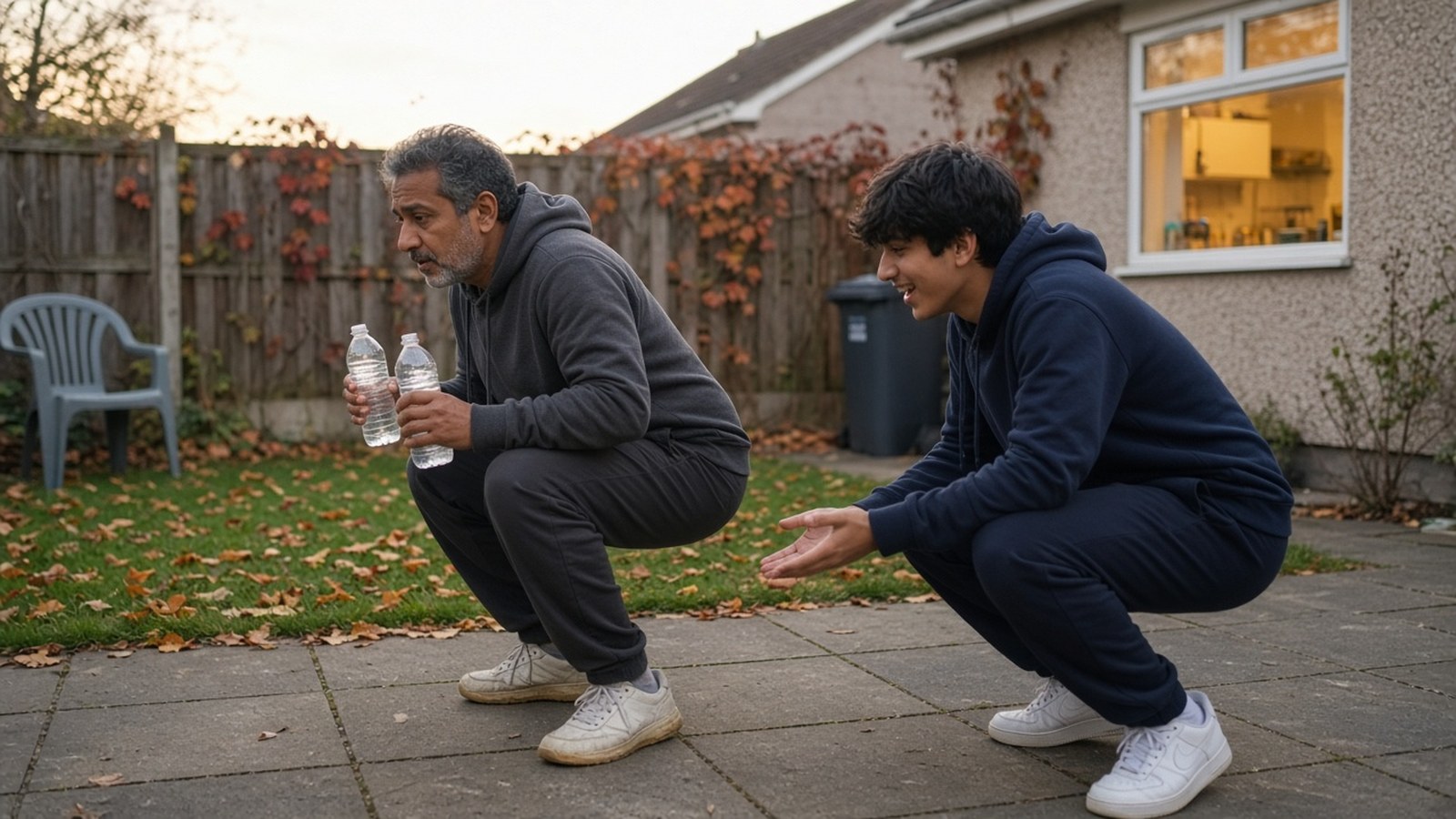
I am reliably informed by Rohan that what I was doing on the patio last night was not a squat. It was, in his words, “a man trying to sit on a chair that isn’t there”. Kiran, who is 14 and therefore an expert in everything, added that my knees were making a noise like the recycling going out. Priya watched from the kitchen window with a cup of tea and said nothing, which in our house is the loudest comment of all.
So how did a pharmacy manager in his fifties end up doing squats in the back garden in late October, holding two full bottles of water like a pair of very sad dumbbells?
Blame the news. Yesterday morning Netmums ran a piece about a big Harvard study on strength training, and Priya sent it to me with no message at all. Just the link. Reader, I knew exactly what she meant.
What the study actually found
Being the sort of person who reads the leaflet inside the medicine box, I found the original. It was published in the British Journal of Sports Medicine back in June, and the BMJ’s own summary is a decent plain read.
The researchers looked at more than 147,000 adults from three long running American studies of nurses and health professionals, following some of them for up to 30 years. Every couple of years people filled in questionnaires about how much exercise they did. Compared with doing no strength training at all, people who did 90 to 119 minutes a week had a 13% lower risk of dying from any cause over the study period. The risk of dying from heart disease was 19% lower, and from neurological diseases such as Alzheimer’s it was 27% lower. Going beyond about 120 minutes a week didn’t seem to add anything.
The lowest risk of all was in people who did plenty of aerobic exercise (walking, cycling, swimming, that sort of thing) as well as some strength work. So it’s both, not one or the other.
Now, the bit I’d underline if this were a prescription. This was an observational study. It shows a link, not proof that the weights did it. The exercise was self reported, most of the people in it were women, and they were nurses and health professionals in the US, who may not be much like a bloke from Leicester who thinks carrying the shopping in from the car counts as cardio. The researchers themselves say more work is needed. But the average age of the people in the study when they joined was 54, and I’m 54, so I decided to take it a bit personally.
Why it got to me
Here’s my confession. I spend a good chunk of my working week telling people at the pharmacy counter to keep moving. “Little and often,” I say, very wisely. And then I go home and sit down.
In my day (I know, I know) nobody’s dad did strength training. My dad worked long shifts, walked everywhere and thought a gym was something you did in PE. His exercise was carrying sacks of rice and lifting his grandchildren above his head until they screamed. I think he was stronger at 60 than I am now, and he never once owned a pair of trainers.
Anjali, who is in her second year in Sheffield, found this all very funny when Priya told her on the family group chat. She sent a gif of an old man lifting weights. I think it was meant to be encouraging.
What the NHS actually says we should do
This is the useful bit, and it’s simpler than I expected. The NHS guidelines for adults aged 19 to 64 say we should aim for:
- strengthening activities that work all the major muscle groups (legs, hips, back, tummy, chest, shoulders and arms) on at least 2 days a week
- at least 150 minutes of moderate activity a week, like brisk walking or cycling, or 75 minutes of vigorous activity like running or football
- less time sat down, and breaking up long stretches of sitting with a bit of moving about
The strength part doesn’t have to mean a gym. The NHS list of what counts includes carrying heavy shopping bags, yoga, pilates, heavy gardening like digging, resistance bands, and using your own body weight with things like press ups and sit ups. To get the benefit you’re meant to work until you need a short rest before you go again. With Diwali on 8 November and the boxes of decorations still in the loft, I am counting the loft ladder as a training aid.
If 90 minutes sounds like a lot, it’s about 13 minutes a day, which is less time than I spend looking for my reading glasses.
How I’m actually starting
I’m not going to pretend I have a plan worthy of a personal trainer. But here’s what I’m doing, and it’s all borrowed from the NHS.
The NHS strength exercises page has a gentle set you can do at home with a sturdy kitchen chair. Sit to stand, mini squats holding the back of the chair, calf raises, wall press ups and bicep curls using water bottles. That last one is where my sad dumbbells came from, so at least I was following official guidance while being laughed at.
Rohan, who is 16 and doing his A levels, has been surprisingly patient. He showed me how to keep my knees pointing the same way as my toes and to go slow on the way down. He also told me my form was “mid”, which Kiran then translated for me as “not good but not tragic”. I’ll take that.
A few things I’d pass on to any dad thinking of doing the same:
- Check with your GP first if you need to. The NHS says to speak to your GP if you haven’t exercised for a while or have any health conditions or worries. If you’re on medication for your heart or blood pressure, it’s a sensible chat to have.
- Get your numbers checked. If you’re 40 to 74 and don’t already have a condition like heart disease, diabetes or high blood pressure, you should be invited for a free NHS Health Check every five years. If you’ve never had the letter, ring your GP practice. Many pharmacies also offer a free blood pressure check for over 40s. High blood pressure usually has no symptoms, so the only way to know is to get it measured. Speaking as someone who does a lot of them, it takes a couple of minutes and nobody judges you.
- Start small and build up. Five slow repetitions is fine to begin with. I did more than five last night and felt it on the stairs this morning, so learn from me.
- Don’t skip the walking. The study and the NHS both say the aerobic stuff matters too. A brisk walk where you can talk but not sing counts as moderate.
- Know when to stop. Achy muscles the next day are normal. Chest pain isn’t. The NHS chest pain page says to call 999 for sudden chest pain or pressure that doesn’t go away, pain that spreads to your arms, neck, jaw, stomach or back, or chest pain with sweating, feeling sick, light headed or short of breath.
The bit about the kids
I’ll be honest, the real reason I’m going back out there tonight is that the kids are watching. Not in a heartwarming way. In a “we are waiting for Dad to give up” way. But Rohan says he’ll join in after his revision, and Kiran has offered, unprompted, to time my wall press ups. That’s more conversation about health than we usually manage at the dinner table.
I don’t want to be the dad who lectures his teenagers about looking after themselves while sat on the sofa with a plate of chevdo. If they see me trying, and failing, and trying again, that might be worth more than anything I say.
Will I make it to 90 minutes a week? Probably not this week. Next week, maybe. Priya says she’ll believe it when she sees it, and to be fair, she has seen me buy a rowing machine before.
Sources: Netmums: 90 minutes of strength training a week could cut your risk of early death by 13%, British Journal of Sports Medicine: Long term resistance training with all cause and cause specific mortality, BMJ Group press release, Harvard T.H. Chan School of Public Health, NHS: Physical activity guidelines for adults aged 19 to 64, NHS: Strength exercises, NHS Health Check, NHS: Blood pressure test, NHS: Chest pain.
Join the Dadsnet crew
Get weekly dad stuff in your inbox, with useful ideas, honest stories and a bit of dad chat from dads who get it.

Join the Dadsnet crew
Weekly dad stuff that actually helps. No spam, just the good bits.