
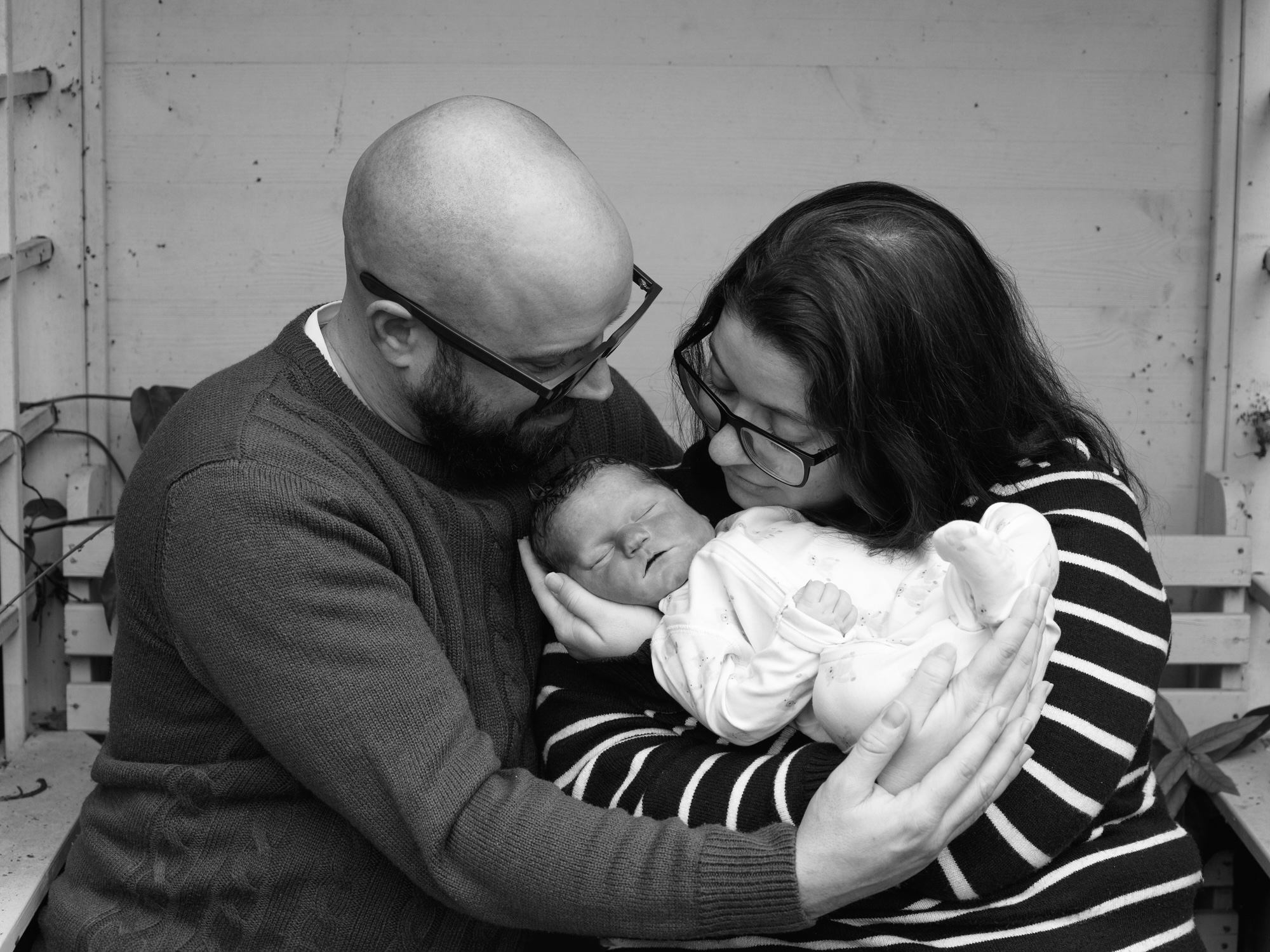
By Richard Webb
“Why isn’t he crying?”
I don’t remember whether I said those words out loud or only in my head.
I remember the silence.
I remember looking at my wife and seeing the anxiety on her face. I remember desperately searching the faces of the medical staff for reassurance. I remember the seconds feeling impossibly long.
And I remember knowing exactly what was happening.
Our son, Ezra, had a rare heart condition. We had known before he was born that he wasn’t expected to live for long. We had already had the difficult conversations. We had already made the impossible decisions.
But knowing something is coming and living through it are two completely different things.
For months, we had been preparing ourselves for the loss of our son.
Nothing prepared us.
When people hear that your baby died, they often focus on the moment of death. The truth is that baby loss is much bigger than that. It’s the weeks before, the hours afterwards, the months that follow, and the person you become because of it.
This isn’t Ezra’s story.
It’s a dad’s story about surviving after losing his son.
And it’s what I wish somebody had told me.
The Decisions No Parent Should Have To Make
One of the greatest gifts we were given was honesty.
From the moment we knew about Ezra’s condition, there were no false promises. We knew that when he was born, our time with him would be measured in minutes or hours rather than years.
Our midwife was extraordinary.
She helped us create as peaceful an experience as possible. She gave us choices when everything else felt out of our control. She allowed me to deliver Ezra myself. She gave us the option not to monitor him constantly.
To some people, that might sound strange.
Why wouldn’t you monitor him?
Because we weren’t trying to save him.
We were trying to meet him.
We weren’t looking for every second of medical intervention. We were looking for every second of parenthood.
There’s a difference.
When you know your child is going to die, your priorities change completely. Suddenly, the most important thing isn’t treatment plans or measurements. It’s holding them. Looking at them. Loving them.
Making sure every moment they have is spent being somebody’s son.
Meeting Ezra
Ezra was born alive.
That’s important for me to say.
Sometimes when people hear his story, they focus only on the fact that he died.
I focus on the fact that he lived.
He was here.
He had sisters.
He had parents who loved him.
At around 3:30 in the morning, his sisters were woken up and brought to meet him. He was around ten minutes old.
Looking back, I’m incredibly grateful that happened.
As parents, we’re constantly told we’re protecting our children from difficult things. But sometimes the greatest gift is allowing them to experience something real.
His sisters got to meet their brother.
They got to hold memories that belong to them forever.
For 72 minutes, Ezra wasn’t a diagnosis.
He wasn’t a prognosis.
He wasn’t a tragedy.
He was simply our son.
The Moment He Died
People sometimes ask whether you know.
You do.
At least I did.
When Ezra died, he was in my arms.
There wasn’t a dramatic moment. There wasn’t a movie scene. There was just a father holding his son and knowing.
I asked for him to be pronounced dead.
Even writing those words now feels surreal.
Because fathers aren’t supposed to do that.
We’re supposed to teach our sons how to ride bikes.
We’re supposed to embarrass them in front of their friends.
We’re supposed to watch them grow up.
We’re not supposed to be the person who asks somebody to confirm they’re gone.
But life doesn’t care what we’re supposed to do.
Sometimes it simply gives us a reality we never wanted.
The Walk Out Of Hospital
Of all the moments from those days, one remains among the hardest.
Walking out of the hospital.
Not because Ezra had died.
Because he was still with us.
We were taking him to Demelza.
I don’t know how to fully explain the feeling of carrying your son out of a hospital knowing where you’re going next.
Every instinct as a parent tells you that you’re supposed to be taking your baby home.
You spend months imagining that journey.
You picture the car seat.
You picture introducing them to the house.
You picture what comes next.
Then suddenly none of those things exist.
Only the reality in front of you.
That walk was heartbreaking.
Even now, I can feel it.
What Nobody Tells Dads
What nobody tells you is that grief isn’t something you get through.
It’s something you become.
People mean well.
Most people genuinely want to help.
But eventually somebody will tell you that you’ll move on.
I know they mean that you’ll find happiness again.
I know they mean that life won’t always feel this heavy.
But they’re wrong about moving on.
You don’t move on.
You change.
You adapt.
You learn to live alongside the aching hole that’s been left behind.
That hole becomes part of your normal.
The grief doesn’t disappear.
You simply get stronger at carrying it.
That’s very different from leaving it behind.
Surviving As A Dad
For a long time, I thought survival meant getting back to who I was before.
It doesn’t.
There is no going back.
The version of me that existed before Ezra died no longer exists.
That isn’t a good thing or a bad thing.
It’s just true.
The challenge isn’t rebuilding your old life.
The challenge is building a new one around a loss that will always matter.
Some days that means talking about him.
Some days it means not talking about him.
Some days it means looking at photos.
Some days it means avoiding them.
There is no correct method.
There is no grief rulebook.
And that’s something I wish more dads understood.
You don’t get marked on how you grieve.
You don’t get points for crying more.
You don’t get points for staying strong.
You don’t get points for suffering in silence.
You simply survive however you can.
As long as you’re not harming yourself or other people, there is no right or wrong way to do this.
What It Did To Our Marriage
People often talk about how child loss can destroy relationships.
They’re right.
It can.
But what they don’t talk about enough is that it can also reveal the strength that’s already there.
The biggest lesson we learned was that grief doesn’t look the same for everybody.
My wife and I lost the same son.
But we didn’t experience that loss in exactly the same way.
Sometimes one of us wanted to talk.
Sometimes one of us didn’t.
Sometimes one of us was having a better day while the other was struggling.
Neither approach was wrong.
The danger comes when you start believing your way is the correct way.
There isn’t one.
The only thing that matters is giving each other the space to grieve honestly.
What Ezra Taught Me
Ezra lived for 72 minutes.
That fact will always hurt.
But it isn’t the whole story.
In those 72 minutes he taught me more about love than I expected to learn in a lifetime.
He taught me that parenthood isn’t measured in years.
He taught me that grief is simply love with nowhere obvious to go.
Most importantly, he taught me that a life doesn’t have to be long to matter.
His life mattered.
He mattered.
He still matters.
If you’re a dad reading this because you’ve lost a child, or because you’re terrified that you might, I want you to know something.
You will survive.
Not unchanged.
Not unscarred.
Not healed in the way people often imagine.
But you will survive.
One day you’ll realise you’ve laughed without feeling guilty.
One day you’ll realise you’ve gone a few hours without thinking about the worst day of your life.
One day you’ll realise you’re carrying the grief differently than you used to.
And when that happens, don’t feel guilty.
You’re not leaving them behind.
You’re taking them with you.
That’s what I’ve done with Ezra.
And that’s what I’ll keep doing for the rest of my life.
Check out Ezra’s tribute site.