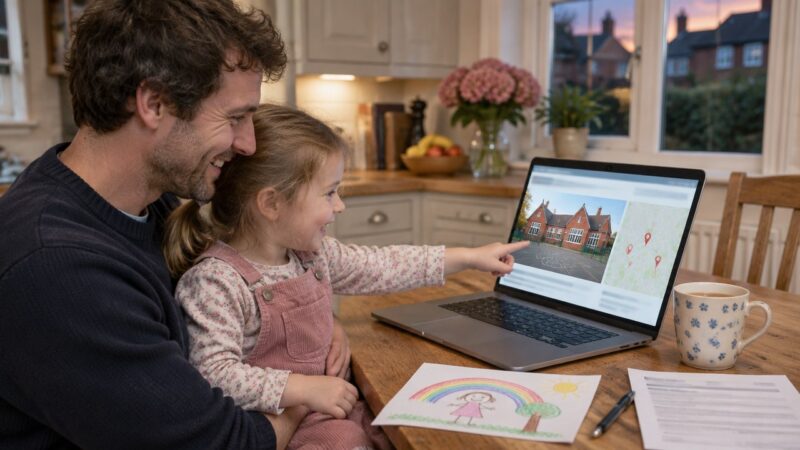
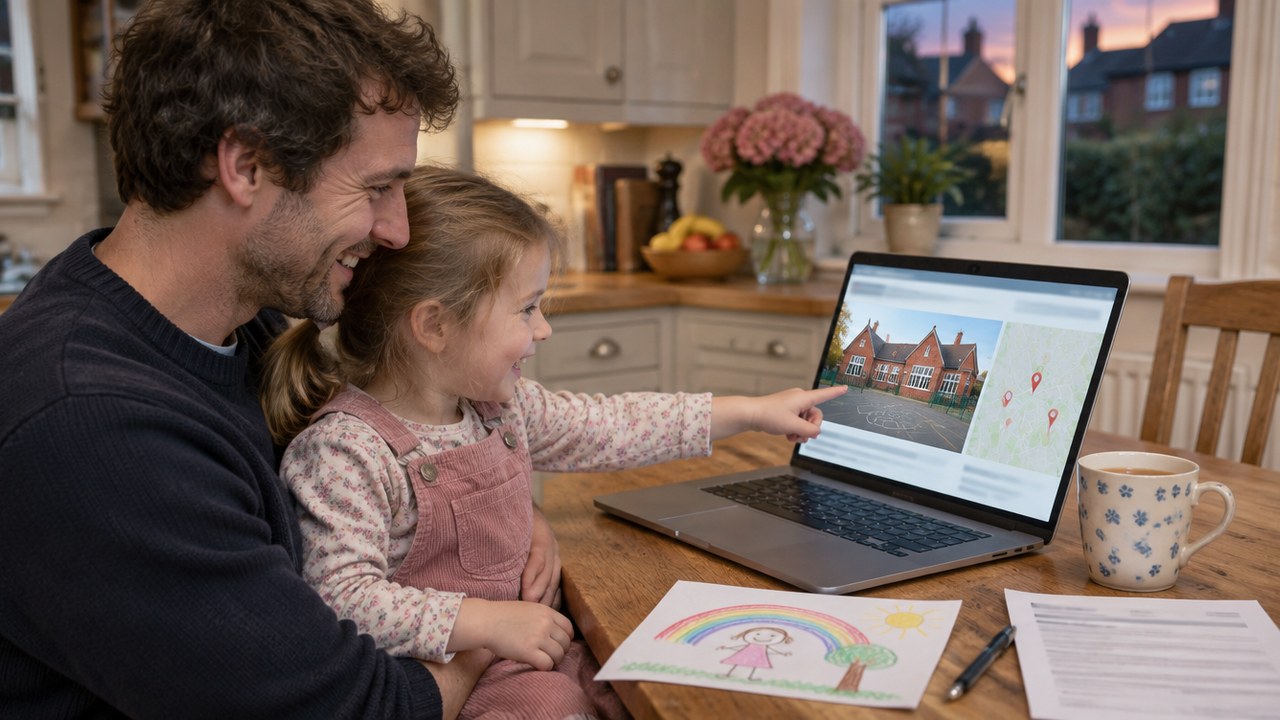
If you’ve ever tried to work out which school to put first on the form, you’ll know the drill. Twelve browser tabs, a council booklet, the school’s own website, an Ofsted report from years ago and whatever got said in the local Facebook group. It adds up to a lot of evenings.
The Department for Education is hoping to cut some of that down. Today, Friday 13 November, it launched a new online service called Find and compare school and college profiles, which puts the basic facts about each school in England on one page. Netmums covered the launch this morning, and the timing isn’t an accident. Primary school applications are open right now and close in January.
Here’s what’s actually in it, what isn’t yet, and the dates worth putting in your phone.
What the new school profiles show
According to the DfE announcement, each school’s profile brings together the questions most parents start with: where it is, the age range, attendance, results, and extras like whether it runs a free breakfast club. You search by school name or by postcode.
For secondary schools there’s a bit more. You can see which GCSE subjects pupils were entered for and what they went on to do after Year 11, whether that’s further education, an apprenticeship or a job. You can also save secondary schools to a list and compare them side by side, which is probably the most useful part if you’re weighing up two or three options.
A few things to know before you dive in:
- Primary comparison isn’t there yet. The side by side feature is secondary only for now. The DfE says it will be rolled out to primary schools, but hasn’t given a date.
- Ofsted reports are coming next year. The department says Ofsted reports will be added to the profiles next year. Until then, you’ll still want to look a school up on Ofsted’s own site, and schools have to link to their Ofsted reports from their websites anyway.
- Clubs and activities come later. Information on what children can do outside lessons, things like sport, arts and nature, is due to be added “in coming years”, tied to the government’s wider curriculum changes.
- It’s a new service. The site is marked as a beta, so expect a few rough edges.
Schools Minister Georgia Gould said: “This is about helping parents become a partner in their child’s education from day one, with more information, more choice, and better outcomes.”
A word on the new Ofsted grades
If you last looked at Ofsted reports when your eldest started school, they’ve changed. Ofsted no longer gives one overall grade like “good” or “outstanding”. Since 10 November 2025, its report cards give separate, colour coded grades for different areas, such as attendance and behaviour, achievement, personal development and wellbeing, and inclusion.
The scale runs from “urgent improvement” through “needs attention”, “expected standard” and “strong standard” up to “exceptional”, and safeguarding is marked as “met” or “not met”. Ofsted is clear that the new grades can’t be compared with the old ones, so a school that was “good” a few years ago and now has a mix of grades hasn’t necessarily got better or worse. And plenty of schools haven’t been inspected under the new system yet, so you’ll be comparing old style and new style reports for a while.
The deadlines that matter
In England, the rules are set out on GOV.UK’s school admissions guide.
- Primary school (starting September 2027): you apply through your local council, and applications close on 15 January. Your child will be 3 or have just turned 4 when you apply. You still have to apply even if their nursery is attached to the school.
- Secondary school: the deadline was 31 October, so that’s been and gone for this year. If you missed it, contact your council now. GOV.UK warns that late applicants are less likely to get one of their chosen schools.
- Offer days: councils send primary offers on 16 April and secondary offers on 1 March, moving to the next working day if either lands on a weekend or bank holiday.
You list schools in order of preference, and GOV.UK is blunt that putting down just one school won’t improve your chances of getting it. It’s worth reading each school’s admission criteria too, because that’s what actually decides places. Distance from home, brothers or sisters already at the school, and faith (for faith schools) are common ones, and your council can tell you how each school does it.
How to use it without overthinking it
The profiles are a good first sift. They’re quick, they’re official and they save you hunting round five different websites for attendance figures. But a page of numbers won’t tell you how a school feels, how it handles a child who’s struggling, or whether the walk there is realistic on a wet Tuesday in February.
GOV.UK’s own advice is still to visit, as most schools run open days, and to talk to other parents. Speaking as someone who teaches in a secondary school, I’d say ten minutes walking round on an ordinary morning tells you more than any table of results.
If you’re separated and share decisions about school with your child’s other parent, it’s worth both of you looking at the same profiles before the form goes in. A shared link is a lot easier than arguing over two different sets of notes.
The DfE is also asking parents for their experience of how schools keep families in the loop, whether that’s apps, parent forums or transition days. A new School Parent Partnership Alliance is collecting views through an online survey, with the best ideas to be tested in more schools from next year.
Not in England?
The new tool only covers schools in England, and so does the 15 January deadline. If you’re in Scotland, Wales or Northern Ireland, the process and the dates are different, so check with your own council or education authority:
- Scotland: look up schools on the School Information Dashboard and see mygov.scot on choosing a school.
- Wales: use My Local School and the Welsh Government’s school admissions page.
- Northern Ireland: see Schools Plus and the Education Authority’s admissions pages.
If you’re in England with a little one due to start next September, the one job this side of Christmas is getting that form in by 15 January. The new profiles might make picking the order a bit less painful.
Join Dadsnet
Weekly dad stuff that actually helps. No spam, just the good bits.