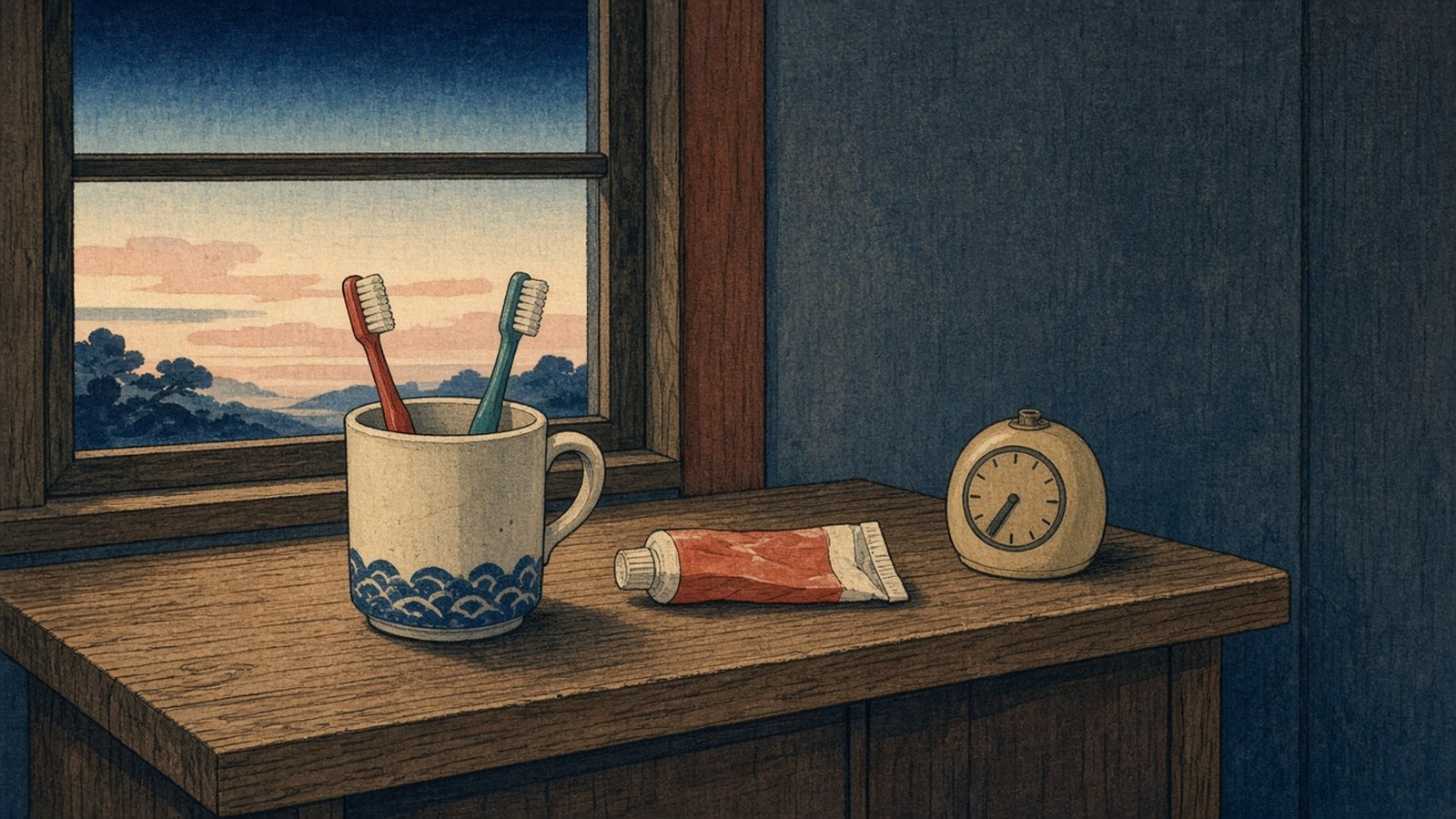
Here’s the thing. Tobi will tell you he has brushed. He will say it with the calm confidence of a Year 4 kid who has already packed his bag and decided bedtime is optional. Then you look at the toothbrush. It is dry. Or damp for about twelve seconds. Or spotless, which somehow feels worse.
I still stand in the doorway.
Zara, who is eleven and in Year 7, mostly gets on with it. Tobi is eight. The NHS says kids of seven and over can brush on their own, but it is still a good idea to watch them. That tip might as well have been written for my house.
This week the news caught up with the doorway habit. On 13 October 2026 the government and Colgate said six million toothbrushes and toothpastes have already gone out to nurseries and schools in the first year of England’s national supervised toothbrushing programme. Joe Wicks has joined the second year push to get families brushing for two minutes, twice a day. I am not usually one for celebrity campaigns. But tooth decay is still the most common reason five to nine year olds end up in hospital in England, and that is not a small thing to shrug at.
What landed this week
The supervised toothbrushing scheme is not brand new. It rolled out as a five year partnership between government and Colgate, with more than 23 million products pledged over that stretch. Early on, the focus was clear enough: up to 600,000 three to five year olds in early years settings, with packs aimed at the most deprived areas, where decay rates are worst.
The October update is a progress stamp. Six million kits delivered. Kits going home as well as being used in class. A public push, with Wicks talking about busy routines, cutting back on all day snacking, and swapping some juices for water. Health minister James Frith has been saying the same sort of thing: habits in the early years matter, and classroom brushing is one way to lay them down when home life is already full.
I teach secondary maths in south London, so I do not see the nursery brush circles myself. But I hear the primary end of it through Funmi, through parents at the gate, and through the odd staffroom chat. Kids brushing as a group. Teachers saying fine motor skills get a quiet workout. Parents getting a kit shoved in a book bag. That last bit is the one that lands for dads who share care. Two homes, one team. If a kit turns up at Mum’s, I want to know what is expected at mine.
Why the hospital numbers still sting
Official figures for the financial year ending 2025 show 33,976 hospital tooth extraction episodes in England for 0 to 19 year olds where tooth decay was the primary diagnosis. That was up on the year before. Tooth decay remains the most common reason for hospital admissions in the five to nine age band.
The gap by area is blunt. Decay related extraction rates in the most deprived communities were just over three times those in the most affluent. Yorkshire and the Humber sat at the high end of regional rates. The East Midlands sat at the low end. London, where we are, sits above the England average on the rate for 0 to 19s.
I am not going to pretend a classroom brush session fixes all of that. Frith has said as much himself: it is not a silver bullet. It is one strand next to water fluoridation plans, school food standards, and the long grind of NHS dentistry access. Still. Prevention that reaches the kids who need it most is worth knowing about if you have a little one, or if you are the dad who ends up packing the book bag on alternate weeks.
What the NHS actually says at home
I like a clear list. Show your working.
Start brushing as soon as the first milk tooth breaks through. That is often around six months, but babies do not read the chart.
Brush twice a day for about two minutes. Last thing at night, and one other time.
Use fluoride toothpaste. Under threes: a smear, with toothpaste that has at least 1,000ppm fluoride unless a dentist says otherwise. Ages three to six: a pea sized amount, 1,000ppm to 1,500ppm. From seven up: 1,350ppm to 1,500ppm.
Spit out. Do not rinse. Rinsing washes the fluoride away.
Help or supervise properly until they can do a decent job. The NHS line for seven and over is that they should be able to brush themselves, but watch them anyway. That is my doorway, right there.
NHS dental care for children is free. Take them when the first teeth appear, or before twelve months, so the place is familiar. Ask about fluoride varnish from age three (at least twice a year for many kids) and about fissure sealants once adult back teeth start coming through around six or seven.
I keep the NHS children’s teeth page bookmarked on my phone. Not because I am organised. Because at half seven, after homework and a row about socks, I am not trusting my memory.
The bit parents actually argue about
If you have ever searched a parenting forum about toothbrushing, you already know the tone. Someone posts that their toddler clamps shut. Someone else says it is not optional. Songs. Timers. Brushing a teddy first. A second dry brush for the kid to hold while you do the real one. And yes, the blunt advice: wrap them in a towel, get it done, praise them after, move on to the story.
I have been that parent. Funmi and I used to tag team it when the kids were smaller. One holds, one brushes, nobody pretends it is a bonding activity. It is closer to giving a cat a tablet. Then you feel bad. Then you remember hospital general anaesthetics for decay and you feel less bad.
With Tobi now, the fight is quieter and sneakier. He will do the front teeth like a toothpaste advert and ignore the back. Or he will brush for the length of one chorus and call it finished. Zara will correct him in the mirror, which he hates, which somehow helps.
What cut the drama for us, first and second:
A sand timer he can see. Two minutes feels abstract. Falling sand does not.
I brush at the same time. Less lecturing, more copy me.
We agree the same rules at Funmi’s. Same fluoride strength, spit do not rinse, no juice in bottles or beakers as a comfort habit. Two homes, one team. If one house is soft on the evening brush, the other house pays for it at the dentist.
We stopped the all evening grazing. Not a moral crusade. Just fewer sugar attacks on the enamel between meals. Water between times. Treats with a meal, not dribbled through the afternoon. Wicks said something similar this week about juices and concentrated drinks. He is not wrong.
If your child is in an early years setting in a priority area, ask whether supervised toothbrushing is happening and whether a take home kit is coming. Do not assume every school is on it yet. Uptake has been uneven in places, and the kits are targeted.
Finding a dentist when it feels impossible
This is the bit that makes dads quietly furious, me included.
Children’s NHS dental treatment is free, but finding a practice taking patients is another story. Use the NHS Find a dentist tool. Ask for an NHS appointment. Be ready for a waiting list.
If it is urgent and you cannot get seen, contact NHS 111. For a child under five, call 111 rather than only using the online service.
Frith has talked about extra dental appointments and training more dentists. Progress on paper is not the same as a slot next Tuesday in Lewisham. Hold both truths. Keep calling. Keep the free child entitlement in your pocket when a receptionist starts the cost conversation by habit.
What I tell myself in the doorway
I am not trying to win Parent of the Year. I am trying to stop an eight year old from learning that “I brushed” means “I held the brush near my face.”
The school scheme will not raise my kids for me. It might give the younger ones a second adult saying the same boring thing. Teachers know that trick. My children rarely do what Dad says first time. They will sometimes do what another adult says while Dad watches from the corridor and pretends not to look smug.
If you only take one thing: brush twice a day with the right smear or pea of fluoride toothpaste, watch them longer than you think you need to, spit do not rinse, and cut the constant sugary sipping. If a supervised brushing kit lands in the book bag, treat it as backup, not a replacement.
And stand in the doorway a bit longer. It is dull. It works better than a lecture.
Sources: NHS children’s teeth, GOV.UK hospital tooth extractions commentary (2025 data), GOV.UK dental health drive (Sep 2025), NHS Find a dentist, NHS urgent dentist help.
Join the Dadsnet crew
Get weekly dad stuff in your inbox, with useful ideas, honest stories and a bit of dad chat from dads who get it.
Join the Dadsnet crew
Weekly dad stuff that actually helps. No spam, just the good bits.